
Bloom’s Taxonomy & Technology Integration
A Privacy-Aware, Accessible Decision-Making Framework for Instructional Design

Who This Guide is For
This guide is intended for faculty and instructors who may not have formal training in instructional design but are responsible for creating instructional materials, training, or assessments. It includes a clear connection between instructional goals, action verbs, and appropriate technology tools.
Why Bloom’s is Useful for Technology
Bloom’s Taxonomy helps instructors avoid misalignment between learning goals and technology use. By first identifying the cognitive level of a learning objective, instructors can select technologies that support the intended type of thinking, rather than relying on tools that promote engagement without meaningful learning.
Overview
Bloom’s Taxonomy is a foundational framework in education that supports the intentional use of learning objectives in design, along with instructional activities and assessments. The Taxonomy was revised in 2001 to emphasize observable cognitive processes. The Taxonomy: Remember, Understand, Apply, Analyze, Evaluate, and Create, provides a shared language for describing what learners will be expected to do with the knowledge, not just what content they are exposed to.
In higher education, particularly in research and healthcare institutions, instructional design decisions are shaped by multiple considerations, including pedagogical, legal, ethical, and accessibility guidelines. Frequently, faculty and staff create training and documentation while also navigating FERPA, HIPAA, and WCAG 2.1AA accessibility standards. Using a structured taxonomy supports the development of learning objectives grounded in universal design principles, ensuring that all learners can access content and are assessed at the intended level of cognitive complexity. Each order of learning includes a corresponding list of actionable verbs to use when creating questions that assess student achievement.
Technology should serve as a tool to support the appropriate level of learning outcomes. Each recommended tool is mapped to a specific Bloom level, with guidance on when to use it, how it supports learning, and why it’s appropriate in instructional contexts.
Instructional Design Rationale
This instructional design philosophy highlights clarity of expectations, universal design that ensures instruction meets the needs of all students, and transfer of learning to real-world tasks. Lower-level cognitive goals that emphasize tools supporting recall. Higher-order goals prioritize analysis, judgment, and creation using approved platforms.
This guide considers accessibility and privacy throughout, reinforcing the principle that universal design strengthens learning for all users. Bloom’s Taxonomy serves as the organizing framework for these decisions, ensuring that technology is selected based on the cognitive work learners are expected to perform rather than on novelty or availability alone.
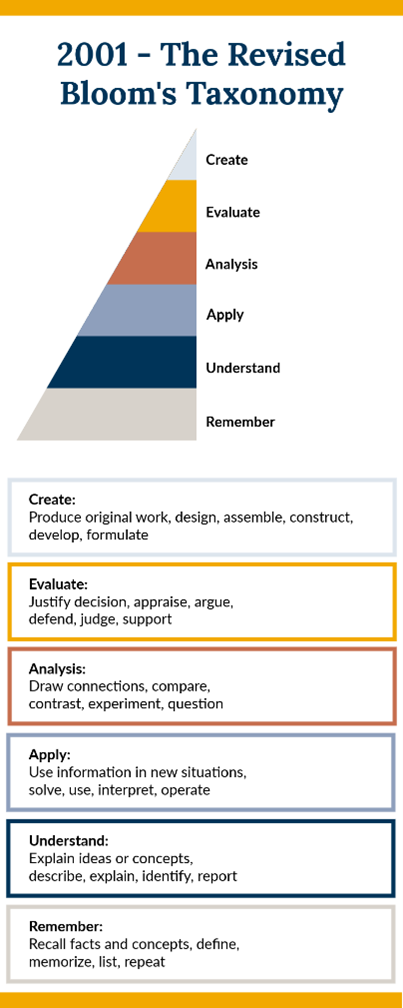
Understanding the 6 Levels of Learning
Remembering: Retrieving and recognizing relevant information from long-term memory.
Understanding: Constructing meaning from oral, written, and graphic messages, summarizing, inferring, comparing, and explaining.
Applying: Carrying out or using a procedure for executing or implementing.
Analyzing: Breaking material into constituent parts and determining how the parts relate to the overall structure through differentiating, organizing, and attributing.
Evaluating: Making judgments based on criteria and standards through checking and critiquing.
Creating: Putting elements together from a coherent or functional whole; reorganizing elements into a new pattern or structure through planning or producing.
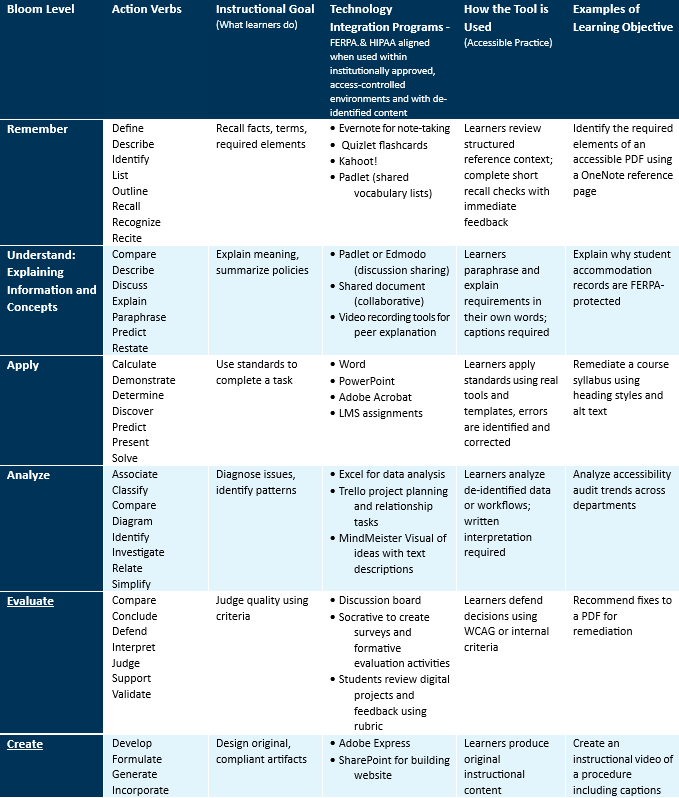
Quick Reference Matrix
Standards considered: FERPA, HIPPA, and WCAG 2.1AA
How to Use Matrix:
1. Start with learning objective verb
2. Identify the Bloom level
3. Select tools that are approved, accessible, and privacy-safe
4. Use the example to check instructional alignment
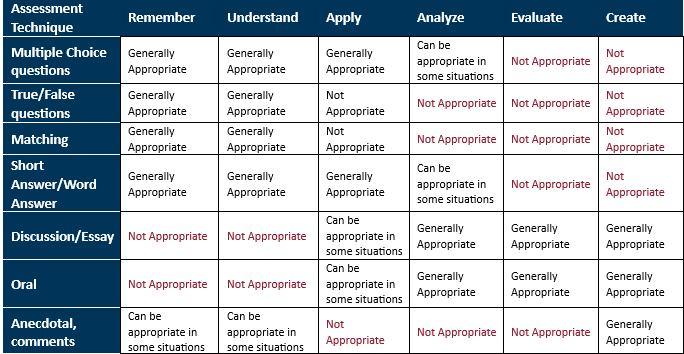
How to Choose an Assessment Method
Bloom’s taxonomy helps educators with designing assessment techniques. Use this to review the type of assessment technique you are using to associate it with the level of learning.
Sources:
Ecampus, O. S. U. (n.d.). Bloom’s Taxonomy Revisited – Artificial Intelligence Tools – Faculty Support | Oregon State Ecampus. Retrieved April 3, 2026, from https://ecampus.oregonstate.edu/faculty/artificial-intelligence-tools/blooms-taxonomy-revisited/
P. L., M.Ed. (2017). Instructional Methods, Strategies and Technologies to Meet the Needs of All Learners: 2.0. ShareAlike. https://www.saskoer.ca/teachingdiverselearners/
Ravishankar, B. (2025, June 20). The Digital Bloom’s Taxonomy: Enhancing Education in the Modern Age. Medium. https://medium.com/@bharathi.ravishankar/the-digital-blooms-taxonomy-enhancing-education-in-the-modern-age-e1096fc56f9d
Soozabdegfar, S., & Adeli, M. (2016). A critical appraisal of Bloom’s Taxonomy. American Research Journal of English and Literature. https://www.scribd.com/document/382009853/A-Critical-Appraisal-of-Bloom-s-Taxonomy-2016